

For most online stores, abandoned carts are simply part of doing business.
A visitor discovers a product, adds it to their cart, starts the checkout process and then disappears. Maybe they got distracted. Maybe they wanted to compare prices. Maybe they weren’t quite ready to buy.
Whatever the reason, every abandoned cart represents revenue that was close enough to touch.
That’s why abandoned cart recovery has become standard practice for e-commerce businesses. A well-timed reminder can bring customers back and recover sales that would otherwise be lost.
But there is another side to the conversation that receives far less attention.
To recover an abandoned checkout, merchants often process customer email addresses, behavioural data and purchase intent signals. In many cases, that information is transferred through a chain of vendors and sub-processors that stretches well beyond Europe.
For businesses that take GDPR seriously, that’s worth paying attention to.
Today, choosing an abandoned cart recovery platform isn’t just about conversion rates. It’s also about understanding where customer data is processed, who has access to it and whether your technology stack aligns with European privacy expectations.
Why Abandoned Carts Cost More Than Most Merchants Realize
Most merchants know abandoned carts are a problem. What many underestimate is the scale of the opportunity they’re leaving behind.
Think about the difference between a first-time website visitor and someone who has already added products to their cart.
The first visitor might be browsing. The second has already shown buying intent.
They’ve looked at products, considered pricing and taken the first steps towards becoming a customer. That’s why abandoned cart recovery consistently delivers some of the highest returns of any e-commerce marketing activity.
The challenge is understanding why customers leave in the first place.
Sometimes it’s something simple. Unexpected shipping costs remain one of the biggest causes of abandoned checkout sessions. In other cases, customers get interrupted, compare competitors or decide to postpone the purchase until later.
Not every abandoned cart can be recovered, and no platform should claim otherwise.
However, recovering even a small percentage of those lost sales can have a meaningful impact on revenue, especially for growing Shopify and WooCommerce stores where every conversion matters.
Why Customers Leave Before Completing Checkout
A customer might be shopping during their lunch break and get pulled into a meeting. Someone else may want to compare alternatives before making a decision. Another visitor may simply feel uncertain about shipping costs or return policies.
Common reasons include:
- Unexpected fees appearing late in the checkout process
- Mandatory account creation
- Concerns about payment security
- Complicated checkout flows
- Slow-loading pages
- Comparison shopping across multiple websites
Understanding these patterns matters because effective recovery starts long before the first abandoned cart email is sent.
The best-performing stores don’t just recover abandoned carts. They actively reduce the number of abandoned carts created in the first place.
The Privacy Side of Abandoned Cart Recovery Nobody Talks About
Ask most merchants how they evaluate an abandoned cart recovery platform and you’ll hear the same answers.
Recovery rate. Ease of use. Integrations. Pricing.
All important considerations.
What rarely comes up is where the data goes once a customer enters their email address.
That’s surprising when you consider the type of information involved. A recovery platform may process email addresses, shopping behaviour, product preferences and purchase intent data. Depending on the implementation, it can reveal a great deal about an individual’s interests and buying patterns.
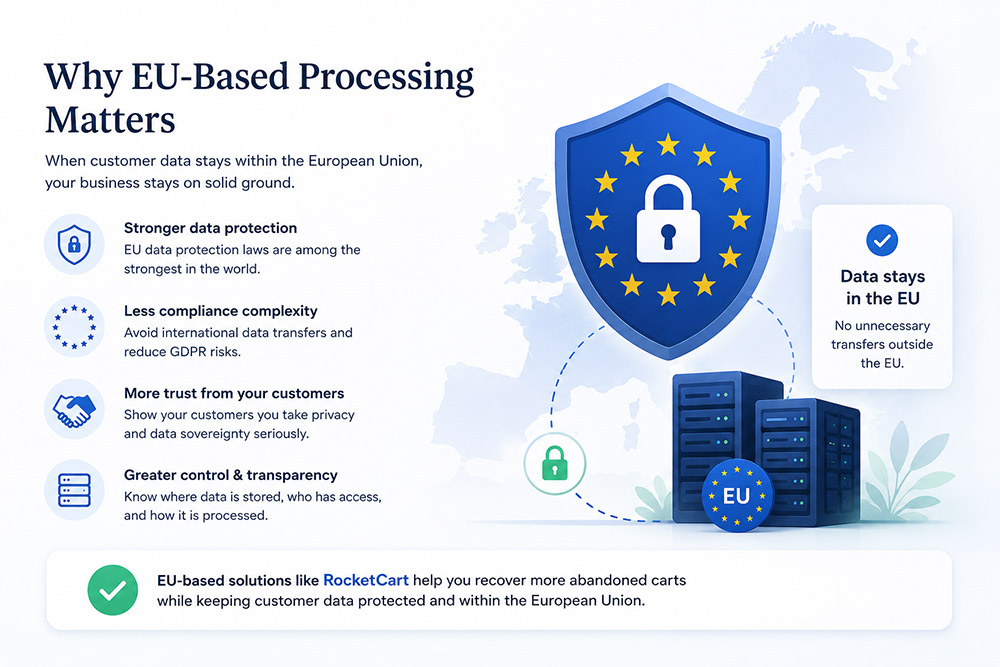 Under GDPR, responsibility doesn’t disappear simply because a third-party vendor handles part of the process.
If customer information is collected through your store, you remain accountable for understanding how that information is processed.
That’s why privacy-conscious merchants are beginning to ask different questions.
Not just “How many carts can this recover?”
But also:
- Where is customer data hosted?
- Which sub-processors are involved?
- Does data leave the European Union?
- How transparent is the vendor about its infrastructure?
- How long is customer information retained?
These aren’t theoretical concerns. They’re becoming part of everyday vendor due diligence for European businesses.
And increasingly, they influence purchasing decisions just as much as features and pricing.
Privacy Is Only Half the Equation
Building a GDPR-compliant abandoned cart recovery process is an important first step. Once your legal basis, consent management, and data processing are in place, the next challenge is making those recovery campaigns perform.
Many WooCommerce stores rely on static email sequences that are created once and rarely updated. They might send a reminder after an hour, another after a day, and perhaps a final email with a discount. While this approach can recover some lost sales, it often misses opportunities because customer behaviour changes over time.
A recovery campaign should evolve alongside your customers. Subject lines, send times, email content and calls to action all influence whether someone returns to complete their purchase. Regular optimization is just as important as regulatory compliance.
If you’re running a WooCommerce store and want to learn how to improve the performance of your recovery emails without relying on constant manual A/B testing, this guide to WooCommerce Abandoned Cart recovery explains how continuous optimization can help recover more revenue while keeping campaign management simple.
Why We Recommend RocketCart
If you’re looking for a practical example of what privacy-conscious abandoned cart recovery can look like, RocketCart is worth considering.
Unlike many recovery platforms that focus solely on sending a standard abandoned cart email sequence, RocketCart uses a self-optimising multi-armed bandit system that continuously tests and improves recovery performance over time. Rather than relying on fixed campaigns or manual A/B tests, the platform automatically learns which combinations of subject lines, timing, content, layouts and calls-to-action generate the best results. Therefore, RocketCart is an exceptional alternative to a Klaviyo abandoned cart flow.
From a compliance perspective, what makes RocketCart particularly interesting for European merchants is its focus on European ownership and EU-based data processing. For businesses that are actively reviewing their vendor stack through a GDPR and data sovereignty lens, this can help reduce some of the complexity that often comes with international data transfers and extensive sub-processor chains.
For Shopify merchants, the setup of the Shopify Abandoned Cart solution is intentionally lightweight. The platform is designed to automate much of the abandoned cart recovery process while continuously optimising performance in the background, allowing store owners to focus on growing their business rather than managing recovery campaigns manually.
In other words, RocketCart addresses both sides of the equation. It helps recover more abandoned carts and abandoned checkouts, while supporting the broader goal of keeping customer data processing closer to home.